Hartung-Gorre Verlag
Inh.: Dr. Renate Gorre D-78465 Konstanz / Germany Fon: +49 (0)7533 97227 Fax:
+49 (0)7533 97228 www.hartung-gorre.de |
S
|
January/Januar 2008
GERMANISTIK
IN IRELAND
Schriftenreihe Volume 1 2008
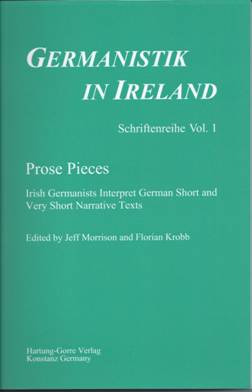
Prose Pieces
Irish Germanists Interpret German Short
and Very Short Stories
1st
edition/1. Auflage 2008, 242 pages/Seiten,
€ 20,00.
ISBN-13: 978-3-86628-185-1
TABLE
OF CONTENTS
Florian Krobb and Jeff Morrison
German Short and Very Short Prose: Introduction............................ 7
Jeff Morrison
Johann Joachim Winckelmann and Johann
Wolfgang Goethe:
Two
Italian Anecdotes............................................................ 19
Rachel MagShamhráin
Georg Christoph
Lichtenberg: Sudelbücher (1765-1799)............... 29
Sascha Harris
Friedrich Hölderlin: Über Achill (1799).......................................... 39
Eoin Bourke
Johann Peter Hebel: Unverhofftes Wiedersehen (1810).................. 47
Jochen Bedenk
Heinrich von Kleist Baxer Anecdote
(1811)................................... 59
Siobhán Donovan
Jacob and Wilhelm Grimm: Der alte Großvater und der Enkel /
....... Die Sterntaler
(1812).............................................................. 69
Florian Krobb
Theodor Storm: ‘Dree to Bedd’ (1845)........................................... 81
Florian Krobb
Marie von
Ebner-Eschenbach: Die Brüder (1909).......................... 89
Karl-Bernhard Bödeker
Franz Kafka: Vor dem Gesetz (1915)............................................. 99
Arnd Witte
Franz Kafka: Auf der Galerie (1918)............................................ 111
Noel Deeney
Klabund: Die
heiligen sieben Schläfer (1921).............................. 119
Valerie Heffernan
Robert
Walser: Lange wohnte sie nun schon
....... im
Turm der Geduld (1929).................................................. 133
Hans-Christian Oeser
Bertolt
Brecht: Wenn die Haifische Menschen wären
(1948)........ 141
Regina Standún
Jeannie Ebner: Fortschritt (1956)................................................. 151
Una Carthy
Heinrich Böll: Redensarten (1957)............................................... 159
Regina Standún
Helmut Qualtinger: Die Ahndlvertilgung
(1958)........................... 169
Eoin Bourke
Heinrich Böll: Anekdote zur Senkung der Arbeitsmoral
(1963).... 177
Moray McGowan
Günter Kunert:
Das Bild der Schlacht am Isonzo
(1964).............. 191
Hans-Walter Schmidt-Hannisa
Elias Canetti: Die Brotwahl (1968)............................................... 199
Andreas Stuhlmann
Günter Eich: Ein Nachwort von König Midas (1968) .................. 209
Eoin Bourke
Stella Rotenberg:
Chronik (1986)................................................. 223
Carmel Finnan
Peter Bichsel:
Das Lob der Armut (1991)..................................... 233
List of
Contributors...................................................................... 242
Review
in Germanistik in Ireland, Yearbook 2008, Vol. 3,
pages 201-203
Jeff
Morrison and Florian Krobb (eds.): Prose Pieces:
Irish Germanists Interpret
German Short and Very Short Narratives. Konstanz: Hartung-Gorre, 2008 (=
Germanistik in Ireland,
vol. 1). 242 pp. ISBN 978-3-86628-185-1.
Short
and very short forms of prose writing play a significant role in the rise of
literary modernism in German, Austrian and Swiss literature, subverting
existing genre conventions, transforming established modes of writing and
creating an entirely new field of competing and overlapping sub-genres and
traditions as a crucial site of literary innovation. Since the seventeenth
century, short prose often undercuts the distinction between high literature
and pragmatic forms of writing while also exploring – and increasingly
combining – poetic, narrative, essayistic, descriptive, reflexive, and diaristic techniques. While some sub-genres (such as the
aphorism, the prose poem or the short story) have attracted quite extensive
research, scholarship’s traditional focus on more established larger genres
(such as the novel), invested with more ‘cultural capital’ (Bourdieu) in
aesthetic debates and academic criticism, is reflected in a general lack of
research in the field of short prose genres. It is in this context that
Morrison’s and Krobb’s collection of readings of
narrative short prose pieces by Irish Germanists
makes a significant contribution to international German Studies.
The
editors’ primary ambition, however, is more pragmatic. Drawing on the
experience of teaching German literature at Higher Education level and
targeting undergraduate students of German as well as non-professional readers
of German literature, they draw on the expertise of Irish German Studies to
present a series of chapters on selected short prose pieces from the late
eighteenth century to the early 1990s, engaging readers in the close reading of
these texts and introducing them to the academic study of literary works, and
of the historical, literary and cultural issues which they raise. All chapters
follow roughly the same pattern. They include the full text of the prose piece
discussed in the German original as well as in an English translation, then
they offer introductory and contextual information on the author and the piece,
present close textual analysis, and develop aspects of an academic discussion
of relevant themes, techniques, traditions and/or contexts with some selected
reference to research (listed in short bibliographies). Conceived as a text-book
and taking Morrison’s and Krobb’s Poetry Project:
Irish Germanists Interpret German Verse (2003) as
a model, the volume thus also showcases Irish German Studies, combining
contributions from a range of institutions and from both established scholars
and early career researchers or teachers.
The
focus on narrative reflects a tradition in short prose editing for the purpose
of teaching; anthologies of short prose by German publishers targeting German Alevel students (such as Reclam
and Klett) also concentrate on narrative.
Interestingly, however, the texts selected by Morrison’s and Krobb’s contributors often reflect the overlap between
narrative and other forms of short prose writing in the works of modern
authors, taking textual analysis to key problems in the discussion of modern
short prose at large. In terms of historical range, the volume starts with
Winckelmann and Goethe in the late eighteenth century and covers the nineteenth
century, modernism, and the post-1945 period with a number of authors and
chapters each, while the contemporary period is only given two pieces and could
have been represented more strongly. The choice of authors includes some of the
leading figures in short prose writing, such as Lichtenberg, Kleist, Hebel,
Robert Walser, Kafka, Canetti and Eich, while some
equally important writers in the field (such as Altenberg,
Musil, Benjamin, Kaschnitz,
or Botho Strauß) are
missing. However, readings of pieces by less prominent authors of short prose
(such as Klabund, Qualtinger
or Rotenberg) are in themselves evidence of the richness of the field and open
up interesting avenues of both literary and cultural discussion. The volume is
particularly successful in exploring the ‘calendar story’ (Kalendergeschichte)
and its legacy, a genre which epitomizes the close relationship between
specific forms of short prose and the media in which they are published, as
discussed in the editors’ introduction. The calendar story also questions the
boundary between ‘high’ literature and popular forms, as does the fairy tale (Märchen), which also features prominently and
illustrates the significance of oral traditions for short prose, highlighted by
the editors.
Similar
to poetry, very short pieces of prose lend themselves naturally to the approach
chosen in this volume, i.e. the combination of close readings of individual
pieces with a selective discussion of wider themes and contexts. Some
contributions are particularly successful in using this format, at times taking
this text-book approach to research level. In the first chapter, Morrison’s
discussion of two Italian anecdotes by Winckelmann and Goethe raises key issues
in German Classicism, highlighting the significance of aesthetic experience in
late eighteenth century thought. Bedenk’s reading of
one of Kleist’s famous anecdotes combines in-depth textual analysis with
cultural contextualization (the history of the duel and sports), exploring
Kleist’s central theme of epistemological crisis. Bourke uses Hebel’s miniature
novella Unverhofftes Wiedersehen, the
most famous version of the Falun mining incident, as an example of the calendar
story while also highlighting the fascination of recurring motifs in literary
history. In Donovan’s discussion of two of the Grimms’
fairy tales, explicit reference to literary sources and to changes in narrative
culture achieve a similar sense of literary experiment and historical
development. Krobb’s chapter on a small story by
Storm returns to the calendar story and uses references to Greek philosophy to
raise awareness of the significance of cultural history and context for the
reading of literature.
Arguably,
short prose is particularly suitable material for introducing students to the
academic study of literature at university level. This edited volume presents a
largely successful collection of case studies for the teaching of German
literature in the English-speaking world. It also ties in with recent German
attempts at more systematic research in the structure and history of short
prose at large.
Dirk Göttsche (Nottingham)
Volume
2 (2013)
Regina Standún
Das österreichische und irische ländliche Volksstück des
20. Jahrhunderts
als
Ausdruck nationaler Selbstdarstellung auf der Bühne: Ein Vergleich
1st
edition/1. Auflage 2013, 240 pages/Seiten, € 20,00.
ISBN 3-86628-465-9
ISBN-13:
978-3-86628-465-4
Volume 3 (2013)
Ann
Murray
Proceedings
of the Postgraduate
Conference
in German Studies
University
College Cork, May 2011
1st
edition/1. Auflage 2013, 146 pages/Seiten,
€ 20,00.
ISBN 978-3-86628-487-6
The Series of the
Yearbooks / Die Reihe der Jahrbücher
Order in your bookshop or directly at / Buchbestellungen in Ihrer Buchhandlung oder
direkt bei:
Hartung-Gorre Verlag
D-78465 Konstanz / Germany
Telefon: +49 (0)7533 97227
Telefax: +49 (0)7533 97228
http://www.hartung-gorre.de
eMail: verlag@hartung-gorre.de