Hartung-Gorre Verlag
Inh.: Dr.
Renate Gorre D-78465
Konstanz Fon:
+49 (0)7533 97227 Fax: +49 (0)7533 97228 www.hartung-gorre.de
|
S
|
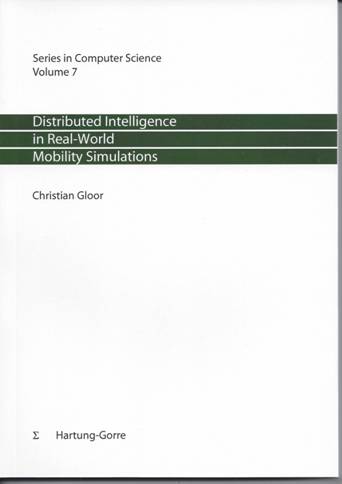
Series in
Computer Science
Edited by Thomas M. Stricker
Vol. 7
Christian Gloor,
Distributed Intelligence in
Real-World Mobility Simulations
2005; XVI, 174 pages/Seiten, € 64,00. ISBN 3-86628-029-7
This work presents a multi-agent simulation which
models the activities of tourists. The goal is to have these agents populate a
virtual world, where they are able to evaluate different development scenarios.
At the same time, the project is used to explore general computational
implementations of mobility simulations.
Our approach is to model each tourist individually as an agent. A synthetic
population of tourists is created that reflects current visitor demographics.
These tourists are given individual goals and expectations, and are introduced
into the simulation with no knowledge of the the
environment. They execute their plans, receiving feedback from the environment
as they move throughout the landscape. At the end of each run, the agents'
actions are compared to their expectations.
This work has a strong computational component. Besides the presentation of the
framework and its modules, computational aspects of the pedestrian simulation
are discussed. Using sophisticated techniques which adapt the model to the
rather special circumstances of hikers in the alps, it
is now possible to simulate an area of 15km^2 and more on a single CPU.
Christian Gloor studied Computer Science at the Swiss Federal Institute of Technology
Zurich. Within the project "Planning with Virtual Alpine Landscapes and
Autonomous Agents", he was responsible for the technical implementation.
Keywords: Simulation,
Multi-Agent Systems, Distributed Computing
Buchbestellungen in Ihrer
Buchhandlung, bei www.amazon.de
oder direkt:
Hartung-Gorre Verlag /
D-78465 Konstanz
Telefon: +49 (0) 7533
97227 Telefax: +49 (0) 7533 97228
http://www.hartung-gorre.de eMail: verlag@hartung-gorre.de