Hartung-Gorre Verlag
Inh.: Dr.
Renate Gorre D-78465
Konstanz Fon: +49 (0)7533 97227 Fax: +49 (0)7533 97228 www.hartung-gorre.de
|
S
|
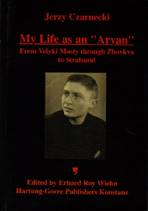
Jerzy Czarnecki
My Life as an "Aryan"
From Velyki Mosty
through Zhovkva to Stralsund.
Edited by Erhard Roy Wiehn
1st Edition 2007, 192
pages, many colored reproductions.
€ 14,80. ISBN 3-89649-998-X
Erhard Roy Wiehn (Editor):
A Struggle for Survival
This is a gripping tale of struggle for survival. Jerzy Czarnecki was born in 1924 in the shtetl Velyki Mosty, a small town in
eastern Galicia, then part of southeastern Poland. In his family, pious men and
women observed the beautiful old Jewish customs and rituals. These were living
traditions, kept all through the week and year. Jerzy had a brother Jacob slightly
older than him, and a brother Shmuel (Samuel), eight years his junior. His
father ran a successful business for building materials. Jerzy's mother took
care of the children and household. She was an avid reader and had a developed
interest in cultural and social life.
The attack by the German armies on September 1, 1939 following the
Ribbentrop-Molotov pact brought vast changes as the family came under Soviet
control. This lasted for 22 months, with both drawbacks and advantages. On the
one hand, it ushered in the expropriation of all "capitalist private
property." On the other, it held out the possibility of relative civil
equality for all Jews.
On June 21, 1941, Germany invaded the Soviet Union. Eight days later, on
June 29, 1941, Velyki Mosty
was taken by German soldiers. A wave of looting by the local population against
the Jews erupted immediately, and the occupiers began to round up Jews for
forced labor. On his first day as a forced laborer, Jerzy had still not turned
16. His name then was Izaak Steger. He had luck with
the group he was assigned to. Another was marched out into the woods, forced to
dig their own graves and then shot. The authorities repeatedly ordered new
"contributions" - a form of compulsory levies imposed on the Jews.
Again and again, the Germans carried out "operations," seizing Jews
and transporting them by force, chiefly to the nearby death camp of Belzec.
Jerzy decides to flee. His odyssey takes him from one hiding place to
the next, finally to Warsaw. Later he manages to make his way to Germany as a
Polish forced laborer. Here he is deployed on an agricultural estate near
Stettin. After getting into a fight with an "ethnic German" foreman,
he is forced to flee once more. Jerzy is arrested and then tortured almost to
death in the Gestapo prison in Stralsund:
I felt this torture was a form of degradation for my mother. Had she
ever had any premonition, she would never have brought me into this world. I
saw her crying. This situation went on for many hours. Suddenly I was relieved.
I found a way out. I swore an oath to my mother that I would study after the
war. And would correspond to the image of what she wanted of me. Exactly as she
had brought me up. As a scientist in the field of nuclear energy, I can say
now, 13 years after my retirement that I kept my solemn promise (p. 58).
Jerzy is confined to hospital twice, and survives. Then he is
transferred to a wood processing plant, and also manages to survive the last
year of the war. He is liberated by the Red Army. In mid-June 1945, he arrives
in Warsaw, then a city totally devastated. There he learns that his brother
Jacob has survived, but that his parents, younger brother Samuel, his four
grandparents, Uncle Moses (p. 90), his wife and child, the brothers and sisters
of his mother and their families, and almost everyone in the shtetl have all
been murdered. The terrible fate suffered by the family is described by his
aunt Hela Graubart.
Today he still uses the assumed name of the forged passport, a document
which made possible his survival. Since the anti-Jewish violence of 1968 in
Poland, he has made his home in Switzerland. Again and again he is troubled by
a recurrent experience: that people are weary of hearing about the Holocaust.
This is the reason he decided to record his memoirs, a compelling narrative of
survival.
The author deserves our great gratitude for his work of memory
"Mein Leben als 'Arier'" (German edition, Konstanz 2002/2007) –
"My Life as an 'Aryan'" (2007) - and of course our congratulations
for his outstanding as well as exemplary project of creating a memorial on the
mass grave of the 1.500 murdered Jews from Velyki Mosty and surroundings in the "Babki"
forest in 2006: Like Yevgeny Yevtushenko complained 1961 in his famous poem
"No memorial at Babi Yar" concerning the
massacre in Kiev 1941, and the first memorial was built in 1976 the Jewish
memorial in 2001 - so Dr. Jerzy Czarnecki fulfilled
the holy duty not to forget, but to remember forever: "zakhor
we lo tishkach"! (5 Moshe 25,17/19;
see Erhard Roy Wiehn, Babij
Jar 1941. Konstanz 2001)
Last not least many thanks to all who contributed to this English
version of Dr. Jerzy Czarnecki's "Life as an
'Aryan'": Prof. Avi Gover
and Joan Gover, Helen Elazari
and Betty Granatstein, Ayala and Gil Proaktor, Zvi Gover
and Yael Gover, relatives of the author and friends
in Ukraine as well as collegues in the University of
Konstanz, especially Gabriela Kruse-Niermann M.A.,
last not least many thanks to Yad Vashem
Jerusalem for taking this publication into the YVS catalogue and for giving
therefore permission to use the YVS logo in this book.
Once such narratives are committed to paper, published and made
available to a broader readership in a number of important libraries, they will
perhaps not be forgotten so swiftly. May this very special book find many
interested readers.
November 9, 2002 – English edition January 27, 2007 – Holocaust Memorial
Day in Germany
Books about Jewish Survivals
from Poland, edited by Erhard Roy Wiehn:
Inhaltsverzeichnis / back to the contents of Shoáh
& Judaica / Jewish Studies
Hartung-Gorre Verlag
D-78465 Konstanz/Germany
Telefon: +49 (0) 7533 97227
Telefax: +49 (0) 7533 97228
eMail: verlag@hartung-gorre.de
http://www.hartung-gorre.de