Hartung-Gorre Verlag
Inh.: Dr.
Renate Gorre D-78465
Konstanz Fon:
+49 (0)7533 97227 Fax: +49 (0)7533 97228 www.hartung-gorre.de
|
S
|
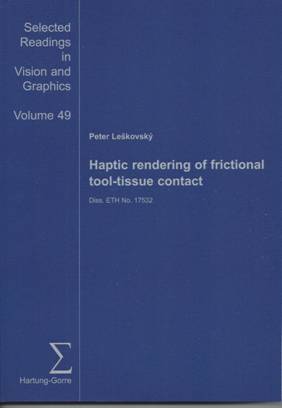
Selected Readings in Vision and Graphics
edited by Luc Van Gool, Gábor Székely,
Markus Gross, Bernt Schiele
Volume 49
Peter Leškovský
Haptic rendering of
frictional tool-tissue contact
First edition 2008. 198 pages (10 of them in color), € 64,00.
ISBN-10: 3-86628-207-9. ISBN-13:
978-3-86628-207-0
The sensation of interaction
forces in virtual reality applications enhances the immersion of users in
computer generated environments. It helps them to move objects embedded in the
virtual environments in a natural way by using all the input stimuli they would
get from the real world. The display of contact forces has a big potential in
virtual reality based training systems where high dexterity of tool
manipulation is required. These are for example surgical simulators.
Providing haptic feedback in
surgical simulators is a challenging task, for which the main bottleneck is the
computational power of current hardware. In general, a refresh rate of 1 kHz is
required for a stable force feedback. This is hard to achieve in virtual
environments which
model the interaction with deformable bodies. On one hand it is
due to the high number of degrees of freedom needed for the representation
of the soft body, on the other hand it is due to a possibly large number of
contact points acting at a single moment. In the existing simulators, the force
output has been therefore often simplified, modeling
contacts with single points and with the assumption of frictionless contact.
In this thesis we present two
methods for a realistic 6-Degree-Of-Freedom force feedback, considering
frictional contact between rigid tools and deformable bodies. The first one is
an extension of the popular virtual proxy point method, applied to multiple
contacts. The contact points are treated independently, which promises low
complexity of the algorithm. Nevertheless, it is based on penalty forces, which
can lead to false behaviour under high loads. The second method follows a
constraint based contact formulation, which provides physically more precise
contact forces than the penalty based approach. Nevertheless, it is
computationally more expensive than the first approach, for what it is hard to
compensate in real-time. Therefore, in this method we focus on the development
of an efficient multirate algorithm, which decouples
the full update of the contact forces from their display on the haptic device.
A computationally effective haptic rendering algorithm is achieved by linearising the inverse of the contact Jacobians in the
active space.
To analyse the fidelity of the
provided haptic feedback, we propose a Turing like test, where the participants
have to discern blindly between the groups of real objects and virtually
generated ones. Our pilot studies have been simple in the sense that it allowed
the user to push on the sample only at one point. Nevertheless, they proved
that in our setup we achieved high realism when haptically
presenting soft virtual objects, with the stiffness range of soft tissues, to
the users. As a result, the relative stiffnesses of
the virtual samples have been truthfully recovered by all the participants.
Moreover, we observed, that if little noise is present in the haptic output,
even if being hardly detectable by the users, it unconsciously amplifies the
perceptual difference between the real and the virtual objects.
Finally, the results of these experimets identify the limited stiffness of our haptic
hardware and the not tuned dynamic properties of the virtually generated
objects as the main indicators upon which it is possible to discern between the
real and virtual objects.
About the
author:
Peter Leškovský
studied Computer Science at the Comenius University in Bratislava, Slovakia,
where he obtained his M.Sc. in Computer Science in 2002. His focus was on
Computer Graphics, Combinatorics and Computation. In 2002 he attended a CGC
Pre-Doc program at the ETH Zürich, Switzerland, as a preparation for his future
doctoral studies. In May 2003 he became a member of the Computer Vision Lab at
ETH Zürich. Here he led his research on haptic interaction with soft tissues,
with the focus on generating a realistic real-time 6DOF haptic feedback for a
virtual surgery simulator. The work was performed under the scope of the
European TOUCH-HapSys project. In 2007, he finished
his doctoral thesis and was awarded a Ph.D. degree (Doctor of Sciences) from
the ETH Zürich.
Keywords / Schlagwörter:
PhD, haptics, 6DOF,
contact problem, friction, physically based simulation, virtual reality,
deformable objects, Turing test
Reihe " Selected Readings in Vision and Graphics
"
Buchbestellungen in Ihrer
Buchhandlung, bei www.amazon.de
oder direkt:
Hartung-Gorre Verlag /
D-78465 Konstanz
Telefon: +49 (0) 7533
97227 Telefax: +49 (0) 7533 97228
http://www.hartung-gorre.de eMail: verlag@hartung-gorre.de