Hartung-Gorre Verlag
Inh.: Dr. Renate
Gorre D-78465 Konstanz Fon: +49 (0)7533 97227 Fax: +49 (0)7533 97228 www.hartung-gorre.de
|
S
|
Sven Seren
Low Cost Solar Cells
from Fast Grown
Silicon Ribbon Materials
Konstanz 2007, 144
pages/Seiten; € 64,00.
ISBN 978-3-86628-157-8
Abstract:
Within this
thesis two fast grown silicon ribbon materials are analysed regarding their
utilisation in photovoltaics: RGS (Ribbon Growth on Substrate) and Molded Wafer (MW). Both materials are close to
commercialisation. Cost effective screen-printing based solar cell processes
are developed meeting the specific material characteristics. The interstitial
oxygen content plays a major role here.
Further on,
the new spatially resolved measurement technique iLIT
(illuminated Lock-In Thermography) was developed, which allows the contactless
imaging of heat dissipating loss mechanisms in pn-structures
and solar cells.
Keywords:
solar cell, silicon ribbon, Ribbon Growth on Substrate, RGS, Molded Wafer, substrate, hydrogenation, oxygen, drift cell,
screen-printing, lock-in thermography
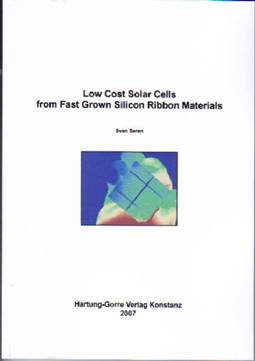
Cover
Picture: Photography recorded with an infrared camera system of a
screen-printed 5x5 cm2 RGS (Ribbon Growth on Substrate) solar
cell with an open rear side metallisation held by hand.
Introduction
This thesis was written
in the winter of 2006 / 2007, which was the warmest winter on record [1]. This
phenomenon is not limited to Germany as the global climate shows the same
trend. The expert group of the United Nations for climate IPCC1 published within its topical report [2] a forecast for
the year 2100. Therein the most probable scenario anticipates a global warming
between 1.7 and 4°C. Should the global warming constitute above three degrees,
the mainland ice of Greenland would melt completely, resulting most probably in
disastrous consequences for the coastal areas of the earth.
A correlation between the
global warming and the increase of greenhouse gas concentrations within the
earth’s atmosphere cannot be neglected any longer, this holds in particular for
carbondioxide and methane. Todays CO2 concentration in the atmosphere is the highest it has
been in the past 650.000 years. Solely the instantaneous reduction of greenhous gases can retard this
progression, which cannot be stopped anymore [2].
How to accomplish this,
in particular when considering the emerging markets? Politics on a global level
can be factored out because from this side no effective decisions are made even
on a local level. This holds in particular for the mainemitting
nations. Because a reduction of the global energy consumption will not take
place, a solution can be found only in a low-emission energy production, as a
CO2 storage solution, for instance in the interior of the
earth, is not available nor would it be sustainable. Uranium as a base for
nuclear fission would wear out rapidly, if a reasonable fraction of the energy
production should be shifted from fossil to nuclear energy sources. Novel
techniques, such as nuclear fusion could not be utilised up to now despite the
enormous effort made so far (JET2, ITER3). Instead of rebuilding the fusion reactor
"sun" on earth, the energy provided by the existing sun could be used
more effectively by means of light and thermal radiation, by wind and water
power, biomass as well as geothermic power.
This work is attributed
to the first attempt, the usage of the electromagnetic radiation of the sun by
photovoltaic conversion into electric energy. For a large
scale energy production solar cells produced from crystalline silicon are the
dominating technique at the moment. For their production quartz sand is reduced
to silicon, which has to be cleaned in the gas phase and is subsequently
deposited as high-purity silicon. For the production of multicrystalline
silicon the material obtained with this technique is crystallised to huge silicon
blocks using an ingot casting process. The ingots were then cut down to smaller
bricks, from which silicon wafers are wire-cut, the base material for solar
cells. Since the diameter of the wire used for the wire sawing process
approximately equals the wafer thickness, a silicon loss of roughly 50% occurs.
Due to segregation- as well as contamination-based processes not the whole
ingot can be wire-sawed to wafers. Areas of the ingot being in direct contact
with the crucible during solidification, as well as upper and lower parts of
the ingot cannot be used, which enhance the fraction of wasted silicon further
above 50%.
A significant enhancement
of the solar fraction of the produced global energy amount can only be reached
by increasing the competitiveness, i.e. by a price reduction. Therefore, cost
reduction within the production chain of solar systems has to proceed. A cost
reduction as a result of mass production, however, is currently limited by a
shortage of available and sufficiently pure silicon. The photovoltaic industry
expanded over the last years with annual growth rates of 30-40%, whereas a
broadening of production capacities for silicon dropped far behind. Until this
bottleneck is overcome and for competitive photovoltaics also beyond it, the
only way is to save silicon, best by using a fast producing and thus cost
effective technique. This leads directly to the content of this work, which
describes the characterisation and the solar cell processing of silicon wafers,
produced very fast and directly from the silicon melt, i.e. without the
indirection of block casting and the silicon loss linked to it.
The first part of this
work presents the silicon ribbon material RGS (Ribbon Growth on Substrate).
Crystallographic investigations as well as the analysis of material
characteristics define the potential of the material, which is still in the
R&D phase. In particular, attention is laid on the interstitial oxygen
content due to its influence on the hydrogen diffusivity which directly affects
the potential for material quality improvement.
For the development of a
suitable solar cell process, adapted to the material quality, basic experiments
are performed concerning the mechanical planarisation
of uneven wafer surfaces, the reduction of cracks induced during planarisation as well as the chemical removal of
defect-rich surface layers. The analysis of particular processing steps leads
to a solar cell process, which avoids local shunts.
A spatially varying
dopant concentration in the wafer can be used to enhance short circuit current
densities of solar cells as a result of a drift-field. Wafer and cell based
experiments are performed to investigate the assumed depth dependent doping
concentration due to segregation and the RGS-specific crystallisation conditions.
Doping with phosphorus, however, leads to n-type wafers which are characterised
and processed to estimate the potential of this material.
To enhance cell
efficiencies, different surface textures are investigated for this material.
Further on, it is tested if scaling effects for the processing of larger RGS
solar cells occur and which impact the reduction of the wafer thickness has on
cell parameters and the silicon usage per output power.
Another silicon ribbon
material, MW (Molded Wafer), will be presented in the
second part of the work. This material is still in the R&D phase as well.
As a result of the production process and combined with an annealing step at
high temperatures, the comparably thick MW wafers show a broad oxygen denuded
zone located in the upper wafer fraction. This wafer fraction represents the photovoltaically active zone in a solar cell process
adapted to the material characteristics. The influence of the annealing step on
the material quality, in particular the annealing temperature, is clarified in
terms of solar cell parameters and advanced cell analysis.
The last part of this
work addresses the Lock-In Thermography, a measurement technique, which allows
the imaging of Joule losses in solar cells already after a very short measurement
time. This is of high interest particularly for the silicon ribbon materials
presented within this work due to a typical inhomogeneous lateral distribution
of the material quality.
The Lock-In calculation
significantly enhances besides the lateral also the thermal resolution of the
measurement setup, which was built up during this work. This enables the
resolution of typical temperature differences produced by shunts in the μK-range. The conventional Lock-In Thermography is
advanced by a new measurement technique, the illuminated Lock-In Thermography (iLIT), which for the first time allows the contactless
measurement of arbitrary pn-structures. This enables
a monitoring of single solar cell processing steps without contamination.
Please pay attention
to these books too:
Christopher
Hebling
Die kristalline Silicium-Dünnschichtsolarzelle
auf isolierenden Substraten.
1999; VIII, 174
Seiten, € 65,45. ISBN 3-89649-455-4
Alexander Hauser
Die kristalline Siliziumsolarzelle.
Untersuchung der Einzelprozesse
und Entwicklung von Alternativen
Erste Auflage 2006; 132 Seiten; € 64,00. ISBN 3-86628-076-9
Sven Seren
from Fast Grown Silicon Ribbon
Materials.
2007, 144 pages/Seiten; € 64,00. ISBN-10:
3-86628-157-9
ISBN-13:
978-3-86628-157-8
Jayaprasad Arumughan
Investigations on Solar Grade Silicon and
Process Engineering of Advanced Silicon Solar
Cells.
2007; 140 pages/Seiten, € 128,00. ISBN 3-86628-184-6
Claudia Strümpel
Application of Erbium-Doped
Up-Converters to Silicon Solar Cells.
Konstanz
2008, 144 pages/Seiten; EUR 128,00.
ISBN-10: 3-86628-201-X
ISBN-13: 978-3-86628-201-8
Helge Haverkamp
Kristalline Silizium-Solarzellen mit selektiver
Emitterstruktur:
Entwicklung, Implementierung und Potential
einer zukunftsweisenden Technologie.
Konstanz
2009, 140 Seiten, EUR 64,00.
ISBN-10: 3-86628-244-3
ISBN-13: 978-3-86628-244-5
Direkt bestellen bei / to
order directly from: verlag@hartung-gorre.de
Hartung-Gorre Verlag Konstanz, http://www.hartung-gorre.de